
What UK land-use figures, agricultural statistics and biodiversity research tell us about solar farms, food security and the countryside.

The opening of examination hearings into the proposed £1 billion East Pye Solar project in Norfolk has once again brought a familiar debate into focus: how much agricultural land should Britain use to generate renewable energy?
At up to 500MW, East Pye is a significant infrastructure proposal. Its overall development boundary covers approximately 1,212 hectares of land across South Norfolk, and concerns around landscape, agricultural land, biodiversity and the cumulative impact of major energy infrastructure deserve proper scrutiny.
But scale needs context.
Because when the national figures are considered alongside the local headlines, the picture of solar competing with British food production becomes considerably more nuanced.
One of the most common concerns surrounding large-scale solar is the amount of agricultural land required.
The Department for Energy Security and Net Zero (DESNZ) has published calculations looking specifically at this issue.
Under the Government's current high-end deployment scenario, ground-mounted solar is projected to occupy around 0.4% of total UK land by 2030.
Even if all the additional solar capacity modelled under that scenario were installed on the ground, DESNZ estimates it would occupy no more than 0.6% of the UK's utilised agricultural land.
That doesn't make land-use concerns irrelevant. The quality and productivity of land being proposed for development still matter enormously.
But it does provide some important perspective.
The debate is not about choosing between having enough land to feed the country or having solar energy. At the national level, the proportion of agricultural land required for solar remains comparatively small.
There is another assumption worth challenging: that land containing solar panels automatically stops being agricultural land.
The latest DEFRA agricultural land-use statistics for England provide a useful insight.
In June 2026, approximately 9,400 hectares of land on registered agricultural holdings was recorded as being used for solar panels.
Of that, 4,400 hectares, just under half, was also being grazed or used for agricultural production.
The figures don't capture every large-scale solar park in England, because the agricultural survey excludes sites solely dedicated to energy generation where they are no longer part of a registered agricultural holding.
Nevertheless, they demonstrate something important.
Energy generation and agriculture do not necessarily have to be competing land uses.
Sheep grazing is already used on some solar farms, while emerging approaches to agrivoltaics are exploring how agricultural production and solar generation can be designed to coexist more effectively.
For comparison, England had approximately 8.8 million hectares of utilised agricultural land in 2026, accounting for 67.7% of the country's total area.
The challenge, therefore, should be to ensure that solar is located, designed and managed intelligently, rather than treating every hectare associated with a solar development as permanently removed from agriculture.
This distinction is particularly relevant to East Pye.
The overall development boundary is much larger than the land that will physically sit beneath solar panels.
The scheme also includes a battery energy storage system, substations, grid infrastructure, underground cable routes, access requirements and environmental mitigation areas.
One of the proposed areas, Site 6, will contain no solar infrastructure at all and has instead been retained for habitat management.
The project's Environmental Statement calculates that land within the overall Order Limits represents approximately 0.22% of Norfolk's land area and 1.2% of South Norfolk's agricultural land.
Those figures come from the applicant's Environmental Statement and should therefore be understood as part of the developer's assessment rather than an independent conclusion.
The agricultural quality of the land also deserves scrutiny.
The East Pye documentation identifies a mixture of agricultural land classifications within the proposed area. Grade 3 land is particularly important to understand because it can be divided between Grade 3a, which is classed as Best and Most Versatile agricultural land and Grade 3b, which is not.
That is exactly the kind of detail the planning examination should test.
The right question isn't simply:
"Is this farmland?"
It is:
What quality is the land, how much will actually be affected, what agricultural activity can continue, how will soils be protected and what happens to the land when the project reaches the end of its operational life?
There is another significant difference between a solar farm and many other forms of development on agricultural land.
Solar infrastructure can be removed.
East Pye is proposed to operate for approximately 60 years. Its planning documents state that, at the end of that period, a decommissioning plan would require the solar panels, battery storage infrastructure and project substations to be removed and the site restored to its original use. The National Grid substation would remain as part of the transmission network.
That does not mean a 60-year change in land use is insignificant.
It does mean it is fundamentally different from permanently covering agricultural land with housing, roads, warehouses or other built development.
Soil management, drainage and the enforceability of eventual restoration should therefore form an important part of the scrutiny applied to major solar projects.
The debate around renewable infrastructure can sometimes create the impression that public support for solar is collapsing.
Government research suggests otherwise.
The DESNZ Public Attitudes Tracker is a nationally representative survey of UK adults.
In Spring 2026, 84% of respondents supported solar energy, making it the most supported renewable technology measured in the survey.
Only 4% opposed it.
Unsurprisingly, attitudes become more complicated when infrastructure is proposed closer to home.
Even then, 46% said they would be happy for a solar farm to be constructed in their local area, compared with 15% who said they would be unhappy. A further 28% said they would not mind either way.
That doesn't invalidate local objections to individual projects. A national opinion poll cannot tell a community what it should think about a development on its doorstep.
But it does challenge the idea that opposition to particular schemes represents widespread opposition to solar itself.
Perhaps one of the most interesting developments in the solar debate is the growing body of evidence around biodiversity.
The simplistic version of the argument runs in two directions: solar farms either "destroy the countryside" or they are automatically "good for nature".
Neither is particularly useful.
The reality depends heavily on what was on the land before, where the development is located and, crucially, how the site is managed.
Research published in 2026 by Lancaster University and its research partners examined biodiversity across 86 solar farms in England and Wales.
Researchers recorded 289 plant species, 25 butterfly species and 81 bird species across the sites studied.
The research found that biodiversity outcomes varied according to factors including soil type, the surrounding landscape and existing habitat.
But one of its most important findings was that site management is an actionable way of improving ecological outcomes.
Sites with greater plant diversity tended to support more butterflies and birds, while solar farms surrounded by hedgerows and lines of trees generally supported greater numbers of those species than sites surrounded by intensively managed arable farmland.
The lesson isn't that putting solar panels into a field automatically improves biodiversity.
It is that the land between, beneath and around energy infrastructure can be actively managed for nature rather than treated simply as unused space.
That should raise expectations of developers.
East Pye is proposed to have a generating capacity of up to 500MW.
The developer estimates that this could generate electricity equivalent to the annual electricity requirements of approximately 115,000 homes.
That wording matters.
It doesn't mean 115,000 specific homes in Norfolk would receive electricity directly from East Pye. Electricity generated would enter the wider electricity system.
But it demonstrates the scale of energy generation being considered in return for the land required.
Britain's transition to a lower-carbon energy system requires considerably more electricity infrastructure: solar and wind generation, battery storage, substations, grid connections, EV charging and reinforcement of the electricity network.
All of it has a physical footprint somewhere.
The challenge is therefore not to pretend infrastructure can be delivered without affecting land or communities.
It is to make sure the benefits justify those impacts and that projects are designed to minimise them.
There are legitimate questions to ask about East Pye and every other major solar development.
Is the right land being used?
How much Best and Most Versatile agricultural land is affected?
Could poorer-quality land have been prioritised?
Can grazing or other agricultural activity continue?
Are biodiversity commitments meaningful and measurable?
How will soils and drainage be protected?
What happens at decommissioning?
What will the host communities gain from having nationally important infrastructure located around them?
And has the cumulative impact of multiple energy projects been properly considered?
Those are difficult questions, but they are far more useful than reducing the debate to a choice between solar panels and food production.
The Government's own figures estimate that even under a high-deployment scenario, ground-mounted solar would occupy no more than 0.6% of the UK's utilised agricultural land by 2030.
At the same time, 84% of the public supports solar energy, agricultural activity already continues alongside panels on thousands of hectares of English farmland and emerging research demonstrates that well-managed solar sites can support significant biodiversity.
None of that means every solar development is appropriate.
It means every development should be judged on the evidence.
As Britain builds the infrastructure needed for a more secure, lower-carbon energy system, the question shouldn't simply be whether renewable infrastructure changes the landscape.
Of course it does.
The better question is whether we are choosing the right locations, protecting the right land, designing schemes intelligently and securing enough environmental, energy and community benefit in return.
That's the standard major infrastructure projects should be expected to meet.
Source note
Department for Energy Security & Net Zero: Ground-mounted solar energy plants, predicted land use
DEFRA: Agricultural land use in England at 1 June 2026
Department for Energy Security & Net Zero: Public Attitudes Tracker, Renewable Energy, Spring 2026
East Pye Solar: Scheme Overview
What UK land-use figures, agricultural statistics and biodiversity research tell us about solar farms, food security and the countryside.
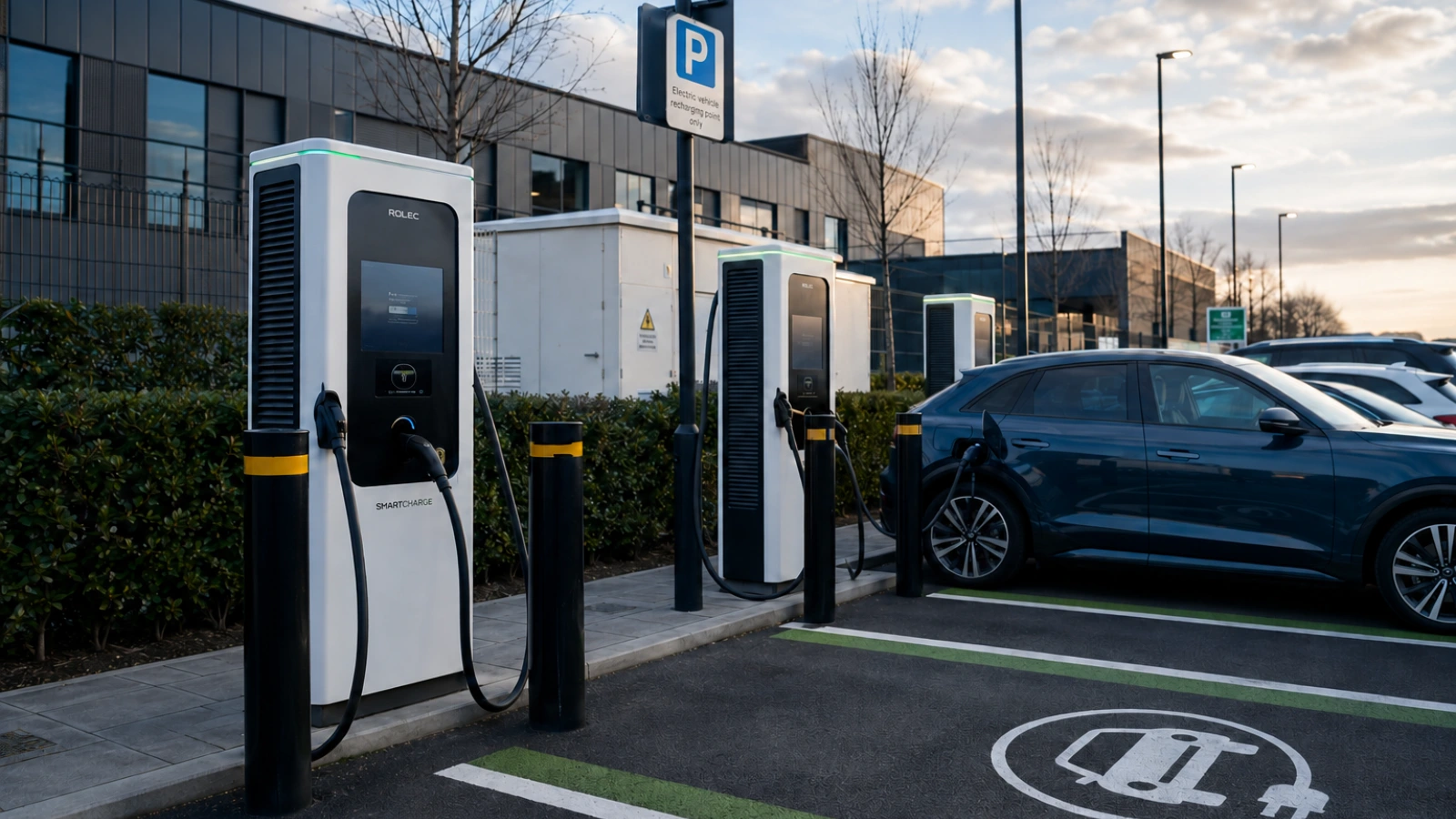
EV charging is shifting from plugs to power, with grid capacity, smart controls and future-ready planning becoming central.
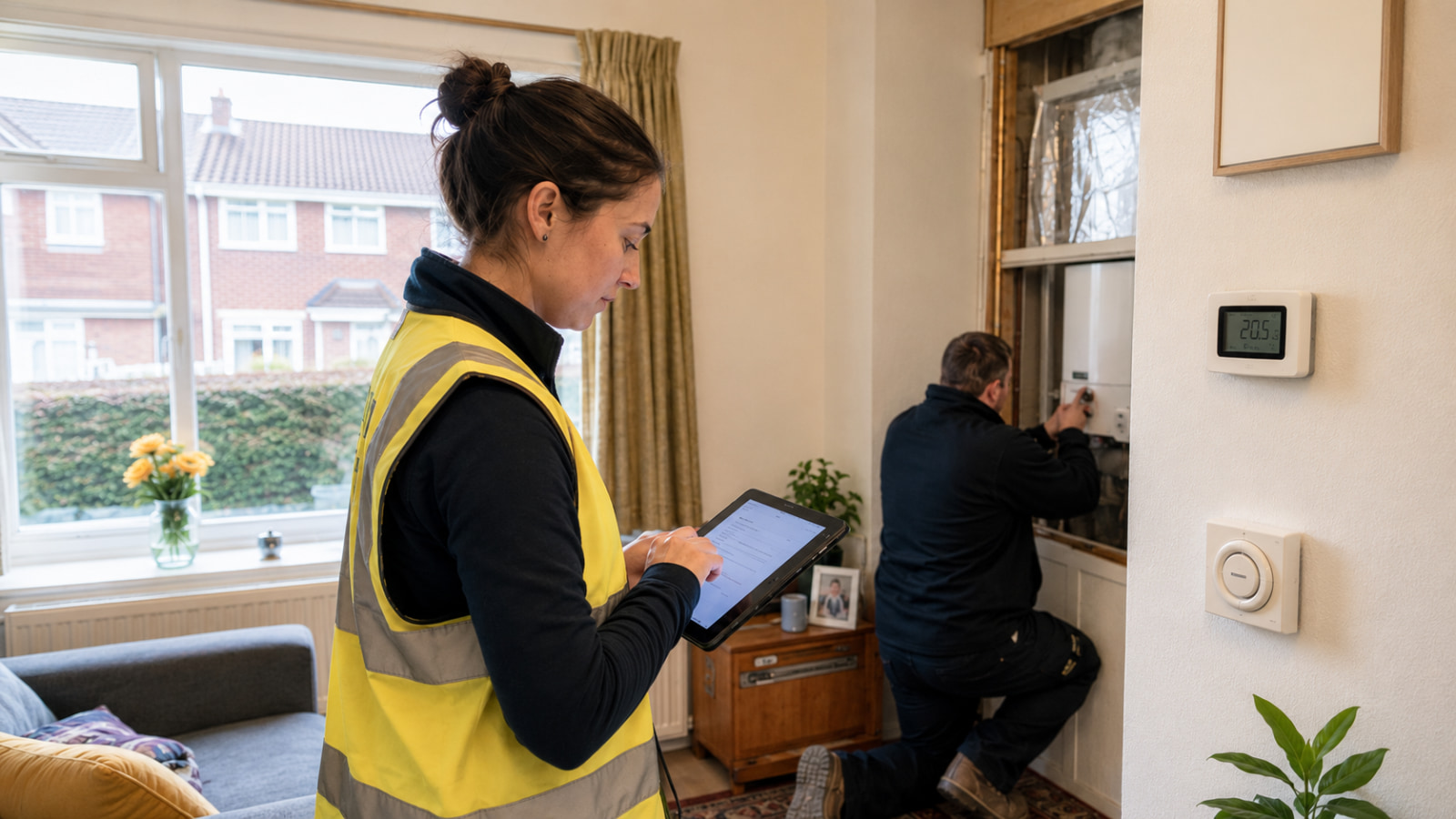
How technical monitoring helps Warm Homes programmes prove quality and improve retrofit outcomes.
Whether you are planning a retrofit programme, reviewing energy infrastructure, exploring funding or looking for a delivery partner, we would be happy to hear from you.


.svg)